World Hijab Day: What It Is, When It Is and How to Join
World Hijab Day is held every year on February 1. It is a grassroots awareness day that invites women of all faiths and backgrounds to try wearing a hijab for one day, learn why many Muslim women cover, and stand against prejudice toward women who wear one. It began in New York and is now marked in many countries.
Key Takeaways
- World Hijab Day falls on February 1 every year, no matter the day of the week.
- It was started by Nazma Khan, a New Yorker who moved to the US from Bangladesh as a child.
- The idea is simple: try a hijab for one day, then talk, listen and learn.
- "Hijab day," "national hijab day" and "international hijab day" are other names people search for the same February 1 event.
- An easy pull-on hijab or a hijab set with a hijab cap makes a first try much simpler.
What Is World Hijab Day?
World Hijab Day is an annual day of awareness about the hijab and the women who wear it. Its organizers describe the goal as encouraging religious freedom and cultural understanding by inviting women "from all walks of life" to experience wearing a hijab for a day.
It is not a religious holiday, and it is not tied to the Islamic calendar. Think of it as an open invitation: Muslim women share what covering means to them, and anyone who is curious gets a chance to ask questions and see the hijab up close instead of through headlines.
If you are new to the topic, our guide to what is a hijab explains the word, what a hijab covers and how it differs from a niqab or burqa.
When Is World Hijab Day?
World Hijab Day is on February 1 every year. The date does not move, so you can plan school events, workplace talks or a small get-together well ahead of time.
In most of the US, February 1 lands in the middle of winter. That matters more than you might think on your first day in a hijab: you will probably be wearing it under a coat, with a scarf collar or a hood, so a soft, warm fabric and a neat wrap make the day much more comfortable.
| Question | Quick answer |
|---|---|
| When is it? | February 1, every year |
| Who started it? | Nazma Khan, a Bangladeshi-born New Yorker |
| Where did it begin? | New York, USA |
| Who can take part? | Anyone: Muslim and non-Muslim women alike |
| What do people do? | Wear a hijab for a day, share stories, host talks, ask questions |
| Is it a religious holiday? | No, it is an awareness day |
| Is it recognized in the US? | New York State has formally recognized it |
How Did World Hijab Day Start?
World Hijab Day started with one woman's experience in New York City. Nazma Khan came to the US from Bangladesh at age eleven and has spoken about the teasing and unkind comments she faced for wearing a hijab at school and in public.
She wanted to turn that experience into something hopeful. Her idea was that if more people tried a hijab for one day, they might understand what it feels like to wear one and treat hijabi women with more kindness. The first World Hijab Day was held on February 1 more than a decade ago, and the event has grown every year since, with schools, universities, community groups and workplaces taking part.
Today the day is run by a nonprofit organization that shares event ideas, stories and resources each year. New York State has also formally recognized World Hijab Day.
Why Do People Celebrate Hijab Day?
People celebrate hijab day to replace assumptions with real conversations. Many women who cover hear the same questions again and again, and some deal with stares or hurtful comments. A day set aside for listening gives everyone a friendly starting point.
The reasons a woman wears a hijab are personal. For many it is an act of faith; for others it is also about identity, family, community or simply feeling like themselves. Our article on why do women wear hijabs walks through these reasons in more detail.
It is also fair to say that not everyone sees the day the same way. Some people, including some Muslim women, question or criticize it, and many voices stress that a woman's choice not to cover deserves the same respect as her choice to cover. A good World Hijab Day leaves room for all of those views.
Is There a National Hijab Day or International Hijab Day?
When people in the US search for "national hijab day" or "international hijab day," they are almost always looking for World Hijab Day on February 1. The names get mixed up because the event is international, and local groups often promote it under their own label.
Some countries and local governments have passed their own resolutions or observances around the same date. If you are planning an event, use the name "World Hijab Day" so people can find it easily, and check with your school, campus or city for any local plans.
How Can You Take Part in World Hijab Day?
You can take part by wearing a hijab for the day, hosting or joining a conversation, or simply learning more and sharing what you learned. There is no sign-up and no single right way to join.
Ideas for individuals
- Try a hijab for a day. Wear it to class, work or errands and notice how people react and how it feels.
- Ask a friend who wears hijab. Many women are happy to show you a simple wrap and answer questions when you ask kindly.
- Share honestly. If you post about your day, describe your own experience and avoid speaking for Muslim women.
- Read and listen. Spend some time with stories written by hijabi women themselves.
Ideas for schools, colleges and workplaces
- Host a "try a hijab" table. Muslim students or coworkers can lead it and show a few easy styles.
- Hold a short Q&A. Invite women who cover to share their experiences, and let them set the boundaries of what they are comfortable discussing.
- Keep it voluntary. No one should be pressured to wear a hijab, and no one should be pressured to explain her faith.
- Plan for winter. Because February 1 is cold in much of the country, an indoor event usually works best.
How Do You Take Part Respectfully?
The respectful way to take part is to treat the hijab as something meaningful, not as a costume. A few simple habits go a long way:
- Wear it neatly and with care, and do not joke about it or use it as a prop.
- Ask before taking photos of women who cover, and do not post anyone without permission.
- Let Muslim women lead the conversation about what the hijab means to them.
- Do not argue about religious rules. People hold different views, and that is a conversation for scholars and the women themselves.
- Remember that one day in a hijab is a glimpse, not the full experience of wearing one every day.
Which Hijab Is Easiest to Wear for the First Time?
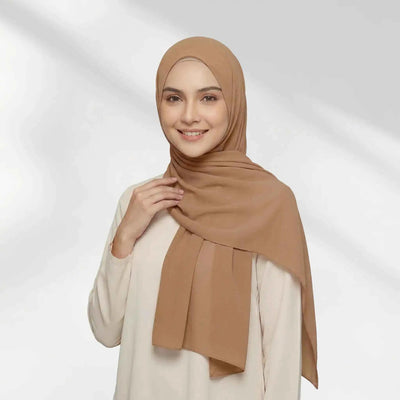
For a first try, an instant (pull-on) hijab is the easiest because there is nothing to wrap or pin. If you want to try a classic wrapped look, a soft modal or jersey hijab with a hijab cap underneath is the most beginner-friendly choice.
Here is how the main options compare for World Hijab Day:
| Hijab type | Fabric | Ease for a first try | Hijab cap included? | Good to know |
|---|---|---|---|---|
| Instant hijab | Polyester and spandex | Easiest: pull it on in seconds | No, scarf only | One piece, no pins needed to wrap |
| Modal hijab set | Modal | Easy with a simple wrap | Yes, free hijab cap | Soft, breathable, smooth drape; 70.9 x 27.6 inches |
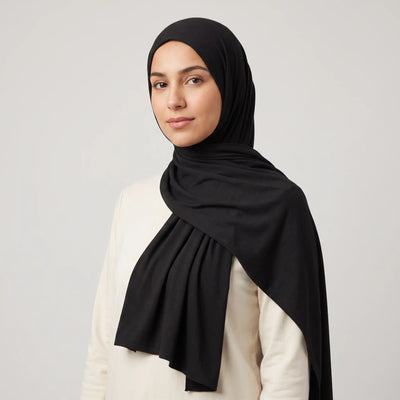
| Jersey hijab set | Cotton jersey and spandex | Easy, very forgiving | Yes, free hijab cap | Stretchy, with a natural grip that makes wrapping simpler |
| Chiffon hijab set | Chiffon | Takes a little practice | Yes, free hijab cap | Light and dressy; usually needs a few pins |
A hijab cap is a snug, stretchy cap worn under the scarf. It covers your hair and gives the hijab a smooth base, which is especially helpful if you have never wrapped one before. The free hijab caps in our sets are soft stretch jersey with no silicone. The black cap is an exact color match; other colors come with a coordinating shade.
If you are curious about all the different styles, from shayla to turban, see our guide to the types of hijabs.
How Do You Wear a Hijab for the First Time?
The simplest way is to put on a hijab cap, drape a rectangular scarf over your head with one side longer, and wrap the long side around and over the opposite shoulder. Here are the steps:
- Put on the hijab cap. Tie or tuck your hair back, slide the cap on and pull it down so it covers your hairline.
- Drape the scarf. Place the hijab over your head so one side hangs about a hand's length longer than the other.
- Pin under the chin. Bring both sides together under your chin and fasten with one pin so the front frames your face.
- Wrap the long side. Take the longer side over the top of your head and let it fall over the opposite shoulder.
- Pin and adjust. Add a pin at the side of your head if needed, then smooth the front so it covers your neck and chest.
- Check the mirror. Tuck in any stray hair and loosen anything that feels tight around your face.
Practice once or twice the night before so the morning feels easy. For more step-by-step wraps, read our guide on how to put on a hijab.
What Should You Wear With a Hijab on February 1?
Pair your hijab with long sleeves and a loose top or sweater, which is easy in February anyway. Choose a hijab color that either matches your coat or softens your outfit, such as beige, brown, black or a muted green.
Wrap the hijab first, then put your coat on, and tuck the ends of the scarf inside the collar so wind does not catch them. If your coat has a hood, a smooth modal or jersey hijab sits comfortably underneath it without bunching.
Where to Buy a Hijab for World Hijab Day
If you want an easy first hijab, our instant hijab styles pull on in seconds, and every hijab set in modal, jersey or chiffon comes with a free hijab cap. Wazi Empire ships from Atlantic City, New Jersey, with free US shipping on orders over $35, delivery in 5–7 business days and 30-day free returns. Order by mid-January to have your hijab in hand before February 1.
World Hijab Day, held every February 1, is a simple invitation to try a hijab, ask honest questions and listen to the women who wear one every day. Join in with respect, keep it voluntary, and pick an easy hijab and cap so your first day feels comfortable from morning to night.