Hijab Meaning: What the Word Means and Why It Is Worn
Hijab is one of those words most people have heard without being sure what it covers. It refers to a garment, a practice, and an idea — and depending on who is speaking, it can mean any of the three.
This guide covers where the word comes from, what the garment actually is, why women wear it, and how it differs from the other terms it gets confused with.
What Does Hijab Mean?
Hijab comes from the Arabic root ḥ-j-b, meaning to cover, to screen or to partition. The word predates its modern use as a name for a garment.
In everyday English, hijab now refers to the headscarf worn by many Muslim women — the one that covers the hair, ears and neck while leaving the face fully visible. In a broader sense, the word also describes the principle of modesty in dress and conduct, of which the headscarf is the most visible expression.
Both uses are correct. Which one someone means usually depends on context.
What Is a Hijab?
A hijab is a headscarf that covers the hair, ears and neck, with the face left open.
Most are rectangular or square pieces of fabric, wrapped around the head and secured with pins or held in place by the fabric's own grip. Pre sewn styles also exist — an instant hijab is sewn into its finished shape and pulls on in one motion, with nothing to wrap.
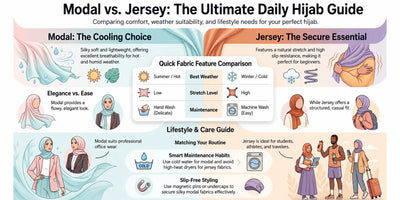
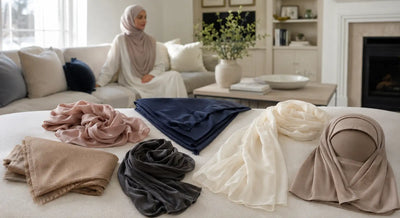
The fabric changes how it behaves more than the style does. Modal is soft and breathable with a fluid drape. Jersey has stretch and grip, so it holds without pins. Chiffon is the lightest and dressiest. Our hijab fabric guide covers each one in detail.
The Definition of Hijab
A headscarf worn by Muslim women that covers the hair and neck but not the face.
The word itself is Arabic for a cover or screen. In Islamic practice it refers both to the garment and to the wider concept of modesty in how a person dresses and behaves — which applies to men as well as women, though the headscarf is what the word most often describes in everyday use.
Why Do Muslim Women Wear Hijab?
For most, it is an act of faith. Many Muslim women understand modest dress as part of their religious practice, and the headscarf as the clearest expression of it.
Beyond that, the reasons vary from person to person. Some describe it as a marker of identity or belonging to a community. Some grew up with it as a family practice. Some began wearing it as an adult decision at a particular point in their life, and some have chosen to stop and start again.
The garment is the same in each case. What it means to the woman wearing it is not, and it is worth being careful about generalising. Women who wear hijab live across dozens of countries and cultures, and the decision behind it is individual.
Is Wearing Hijab Mandatory?
Interpretations differ, and this is a question Islamic scholars have discussed at length without arriving at one universal position.
Many Muslims understand covering the hair as a religious obligation, based on verses in the Quran encouraging modest dress. Others read those same verses as strongly encouraging modesty without specifying the headscarf. Practice varies widely between communities, countries and individual families.
Anyone looking for a definitive answer is best served by speaking with a scholar or teacher within their own tradition rather than relying on a general guide.
Hijab, Niqab and Burqa: What Is the Difference?
These three words are often used interchangeably. They describe different garments.
| Garment | What it covers | Face visible? |
|---|---|---|
| Hijab | Hair, ears and neck | Yes, the whole face |
| Niqab | Hair, neck and the lower face | Only the eyes |
| Burqa | Full body and face | No — a mesh screen covers the eyes |
A khimar is a fourth term worth knowing: a longer, pre sewn covering that falls from the head to the chest or further, with the face left open like a hijab.
How Many Types of Hijab Are There?
Seven styles cover most of what people wear day to day:
- Shayla — a long rectangular scarf, wrapped and draped over the shoulders
- Square hijab — folded into a triangle before wrapping
- Pashmina — longer and heavier, with more drape
- Khimar — pre sewn, falling from head to chest
- Al-amira — a two-piece set with a fitted cap and a tube scarf
- Instant hijab — pre sewn as one piece, slips on in seconds
- Sports hijab — cut and fabricated for movement
The same style feels completely different depending on the fabric it is cut from. Our types of hijab guide covers each style with sizing and styling detail.
At What Age Do Girls Start Wearing Hijab?
There is no single answer. Many start around puberty. Some wear it earlier as a family practice, often for prayer or at the mosque before wearing it daily. Others begin much later as an adult decision.
It varies by family, community and personal choice rather than following one fixed rule.
Hijab in Everyday Life
Whatever the reason behind it, a hijab worn every day has to be practical. That is why fabric matters so much — a scarf that slides back every twenty minutes or traps heat through a summer afternoon gets left in the drawer, however much someone likes the colour.
For most people the answer is two or three fabrics rather than one: something soft and breathable for everyday, something with grip for busy mornings, and something dressier for occasions.
If you are working out where to start, our step-by-step hijab tutorials cover five wraps that take under two minutes each, and the hijab styles guide pulls fabric, face shape and colour together in one place.
Shop Hijabs at Wazi Empire
Wazi Empire is a US-based hijab brand shipping from Atlantic City, New Jersey.
- Modal hijabs — soft, breathable, with a free matching hijab cap
- Jersey hijabs — stretchy cotton jersey that holds without pins
- Chiffon hijabs — lightweight and elegant for occasions
- Instant hijabs — pre sewn, one piece, on in seconds
- Hijab caps — the base layer that stops a scarf slipping
Free US shipping on orders over $35, with 30-day returns.