Face Shape Guide: Hijab Styles for Round, Oval, Square and Heart Faces
Ever followed a hijab tutorial step for step, looked in the mirror, and thought — why doesn't it look like that on me?
Usually it isn't your technique. It's your face shape.
The way you wrap a hijab changes the proportions of your face the same way a haircut does. It can soften a sharp jawline, add length to a round face, or balance a wide forehead. This guide shows you how to work out your shape and which wrap suits it.
Step 1: Find Your Face Shape
Stand in front of a mirror, pull your hair back, and trace the outline of your face on the glass with a washable marker. A straight-on selfie works too.

- Round: width and length are roughly equal, with a soft, curved jawline.
- Oval: longer than it is wide, forehead slightly wider than the jaw. The most flexible shape.
- Square: forehead, cheekbones and jaw all about the same width, with a strong jawline.
- Heart: forehead wider than the jaw, chin comes to a point.
- Long or rectangular: an elongated oval — forehead, cheeks and jaw are similar widths but the face is noticeably longer than it is wide.
Step 2: Hijab Styles for a Round Face
The goal: add length and definition.

What works
- Create a peak. Fold the top of the hijab so it sits slightly higher at the center of the forehead. That small lift adds vertical line.
- Keep the sides loose. Let the fabric fall vertically past the cheeks rather than hugging them.
- Show a little hijab cap. A narrow band at the forehead adds structure — just don't pull it low.
What to avoid
- Tight side pinning. Pinning flush against the cheeks emphasizes width.
- A low forehead wrap. Pulling the hijab or cap down to the eyebrows shortens the face.
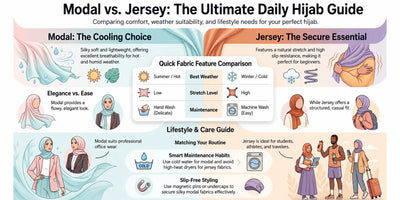
Best fabric: chiffon or modal — both fall vertically rather than holding a shape.
Step 3: Hijab Styles for an Oval Face
The goal: keep the balance you already have.

What works
- Almost anything. Fitted wraps, loose drapes, turban styles — an oval face carries all of them.
- Follow your hairline. Set the front edge where your hairline sits and the proportions look right on their own.
- Try prints. An oval face balances busier patterns that would overwhelm other shapes.
What to avoid
- Too much side volume. Excess bulk at the cheeks can widen the frame unnecessarily.
- Over-covering. Pulling the hijab low on the forehead or high on the chin hides the proportions that make the shape work.
Step 4: Hijab Styles for a Square Face
The goal: soften the jawline.

What works
- Curve around the jaw. Let the fabric follow a soft line rather than a straight one across the jawline.
- Cover both sides of the jaw. That creates a more oval outline.
- Choose fluid fabrics. Chiffon and modal drape and curve. Stiffer fabrics hold angles, which is the opposite of what you want here.
What to avoid
- Tight pinning above the ears. It puts the full width of the jaw on display.
- Sharp geometric prints. They echo the angles instead of softening them — flowing prints work better.
Best fabric: chiffon for the softest drape, or jersey if you want it to stay put without pins.
Step 5: Hijab Styles for a Heart-Shaped Face
The goal: add width at the lower half to balance a pointed chin.

What works
- Volume below the chin. Loose folds or pleats around the neck add the width a heart shape lacks at the bottom.
- Soft height at the crown. A slight peak works here as it does on a round face.
- Turban with a loose end. If you like the turban look, leave fabric hanging at the neck rather than tucking it all in.
What to avoid
- A tight neck wrap. Wrapping close with no volume sharpens the chin further.
- A flat, wide forehead wrap. Pinning the hijab straight across the forehead widens the part that is already widest.
Step 6: Hijab Styles for a Long or Rectangular Face
The goal: reduce length and add width.
What works
- Bring the front edge lower. Set the hijab cap slightly over the forehead — the opposite of the round-face rule.
- Add volume at the sides. Folds or gathers beside the cheeks break the vertical line.
- Keep the cheeks visible. Snug at the jaw, fuller at the sides.
What to avoid
- High peaks. Any height at the crown adds length you don't need.
- Long vertical drapes. Ends hanging straight down pull the eye further downward.
Which Fabric for Which Shape
| Face shape | What you want | Best fabric |
|---|---|---|
| Round | Vertical line, loose sides | Chiffon or modal |
| Oval | Balance — almost anything works | Any |
| Square | Soft curves around the jaw | Chiffon or modal |
| Heart | Volume at the neck | Chiffon or jersey |
| Long | Width at the sides, no crown height | Jersey |
Final Thoughts
Finding your style takes some experimenting. The fastest way is to keep two fabrics on hand — jersey for fitted wraps, chiffon for loose drapes — and spend twenty minutes in front of a mirror trying both.
And treat all of this as guidance, not rules. If a style supposedly wrong for your face shape is the one that makes you feel best, wear it.
Ready to try something new? Browse the full hijab collection, or read our step-by-step hijab tutorials for the wraps mentioned here.